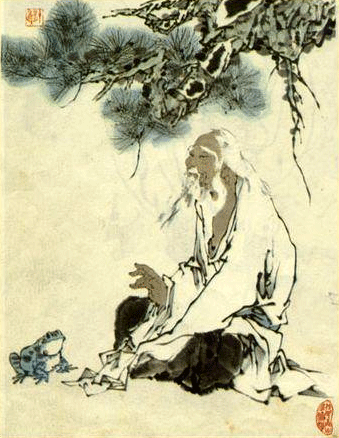
The Depths of Wisdom: Embracing the Unknown
Chuang Tzu's assertion that "the wise man knows what is unknown to others" invites us to reconsider the nature of wisdom itself. In a world often dominated by the pursuit of knowledge and certainty, this quote challenges us to embrace the vastness of the unknown. It suggests that true wisdom lies not merely in the accumulation of facts but in the recognition of our limitations and the mysteries that lie beyond our understanding. This perspective is crucial, as it encourages humility and openness in our quest for insight.
Moreover, this quote serves as a reminder that wisdom is not a static state but a dynamic process of engagement with the world. It calls us to cultivate a deeper awareness of our surroundings and the subtleties that often elude our perception. By acknowledging what we do not know, we open ourselves to new possibilities and insights that can enrich our lives. In this way, Chuang Tzu invites us to explore the interplay between knowledge and ignorance, urging us to find strength in our vulnerability.
The image / the metaphor
The imagery in Chuang Tzu's quote evokes a sense of depth and complexity. The "wise man" represents an archetype of understanding, someone who perceives beyond the surface of things. The phrase "knows what is unknown" suggests a paradoxical relationship with knowledge; it implies that wisdom involves recognizing the limits of one's understanding. The verbs chosen here—"knows" and "is unknown"—create a tension that invites contemplation on the nature of awareness and insight.
In the speaker's tradition
Chuang Tzu's insights are deeply rooted in the tradition of Taoism, which emphasizes the importance of aligning oneself with the natural flow of the universe. Central to this philosophy is the concept of "wu wei," or effortless action, which encourages individuals to act in harmony with the Tao, or the Way. This principle resonates with the idea that true wisdom involves understanding the limitations of our knowledge and allowing life to unfold naturally. In this context, the wise man embodies the essence of "prajna," or transcendent wisdom, which recognizes the interconnectedness of all things.
In the "Zhuangzi," the text attributed to Chuang Tzu, we find numerous anecdotes illustrating the nature of wisdom and the folly of rigid thinking. One such story involves a skilled butcher who, through years of practice, learns to cut meat in a way that aligns with the natural structure of the animal. This tale serves as a metaphor for the wise man's ability to navigate the complexities of life with grace and intuition. Just as the butcher understands the inherent qualities of his craft, the wise man knows how to engage with the unknown, allowing for a deeper understanding of existence.
Living the teaching
Consider a modern scenario where this teaching can be applied: a workplace environment where employees are expected to have all the answers. In such a setting, the pressure to appear knowledgeable can stifle creativity and innovation. However, if individuals embrace the wisdom of acknowledging their limitations, they can foster a culture of collaboration and open dialogue. By admitting what they do not know, they create space for collective exploration and discovery, ultimately leading to more profound insights and solutions.
In the realm of relationships, this teaching can also find resonance. Imagine a couple navigating a challenging conversation where misunderstandings abound. Instead of clinging to their perspectives, if both partners approach the dialogue with the humility of the wise man, they can acknowledge the unknowns in their feelings and experiences. This openness allows for deeper empathy and connection, transforming potential conflict into an opportunity for growth and understanding. By embracing the unknown, they cultivate a relationship grounded in trust and mutual respect.
A reflection
As we reflect on Chuang Tzu's profound insight, we might ask ourselves: What unknowns am I currently avoiding in my life? This question invites us to explore the areas where we may be clinging to certainty or resisting the complexities of our experiences. By acknowledging these unknowns, we can begin to cultivate a deeper sense of wisdom and openness, allowing ourselves to engage more fully with the richness of life.



Join the BrightStar Community
Stay connected with daily inspiration, event announcements, and community wisdom