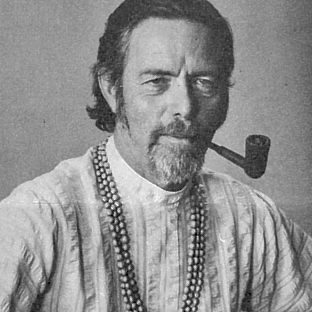
The Essence of Unity: Embracing the Self in All Things
In the profound assertion, "You are it. There is no other," Alan Watts invites us to recognize the intrinsic unity of existence. This statement transcends the boundaries of individual identity, urging us to see ourselves not as separate entities but as integral parts of a greater whole. The stakes of this realization are high; it challenges our conventional understanding of selfhood and beckons us toward a more expansive awareness of our interconnectedness with all that is.
Watts's words resonate deeply in a world often characterized by division and isolation. By declaring that "you are it," he emphasizes that the essence of our being is not found in external validation or material accumulation but in the recognition of our shared existence. This perspective invites us to explore the nature of identity, urging us to peel back the layers of ego and societal conditioning to uncover the fundamental truth of our unity with the cosmos.
The image / the metaphor
The imagery in Watts's quote is strikingly direct yet profoundly layered. The phrase "You are it" suggests a sense of immediacy and presence, as if to say that the essence of life is not something to be sought after but rather something to be acknowledged within ourselves. The use of "it" serves as a reminder that the essence of existence is not confined to a singular definition; it is fluid, encompassing all experiences, emotions, and states of being. This felt sense of immediacy invites us to engage with our own existence in a more intimate and authentic way.
Diving deeper into the metaphor, we can see that Watts is not merely speaking of individual identity but rather of the universal essence that connects all beings. The notion of "no other" challenges the illusion of separation that often plagues our understanding of self. It invites us to consider the interconnected web of life, where every action, thought, and feeling reverberates through the fabric of existence. In this light, the quote becomes a call to awaken to our true nature, to recognize that we are not isolated beings but rather expressions of a singular, unified consciousness.
In the speaker's tradition
Moreover, Watts's teachings echo the principles found in the Heart Sutra, which states, "Form is emptiness, emptiness is form." This text encapsulates the essence of non-duality, suggesting that the separation we perceive is an illusion. By recognizing that "you are it," we begin to dissolve the barriers that keep us from experiencing the fullness of life and the interconnectedness of all beings. In this way, Watts's quote serves as a modern reflection of ancient wisdom, inviting us to explore the depths of our being and the unity that underlies all existence.
Living the teaching
Consider a modern scenario where this teaching might resonate: a moment of frustration in a crowded subway, where the hustle and bustle of life can feel overwhelming. In such instances, the reminder that "you are it" can transform our perspective. Instead of viewing ourselves as isolated individuals navigating a chaotic environment, we can recognize that each person around us is also a manifestation of the same essence. This shift in perception allows us to cultivate compassion and understanding, fostering a sense of connection even in the midst of chaos.
In relationships, the application of Watts's teaching can be equally profound. Imagine a disagreement with a loved one, where feelings of separation and conflict arise. By embracing the idea that "there is no other," we can begin to see our partner not as an adversary but as a reflection of ourselves. This understanding encourages empathy and openness, allowing us to approach the situation with a sense of unity rather than division. In daily practice, we can cultivate this awareness through mindfulness, reminding ourselves of our shared humanity and the interconnectedness of all beings.
A reflection
As we contemplate the depth of Watts's assertion, we are invited to ask ourselves: In what ways do I perceive separation in my life, and how might I shift my perspective to recognize the unity that exists within and around me? This question serves as a guiding light, encouraging us to explore the layers of our identity and the connections that bind us to the world. By engaging with this inquiry, we can begin to embody the essence of Watts's teaching, moving toward a more profound understanding of ourselves and our place within the tapestry of existence.



Join the BrightStar Community
Stay connected with daily inspiration, event announcements, and community wisdom